


For many families, 11+ reading comprehension is one of the most challenging aspects of exam preparation. Not because children cannot read, but because the texts are more demanding, the vocabulary is broader, the inference is deeper, and the time pressure is significant.
This guide is designed to help you understand what 11Plus reading comprehension involves and how to support your child effectively, without unnecessary stress or overload.
Understanding 11+ Reading Comprehension
11 Plus reading comprehension goes beyond standard Key Stage 2 expectations.
The texts are often more complex.
The vocabulary is more ambitious.
The questions require precise, layered inference rather than straightforward retrieval.
A key difference is that grammar knowledge is assumed to be present. In many 11+ papers, grammatical understanding is explicitly assessed within the comprehension section. Children are also expected to identify and explain the effect of figurative language, sentence structure, and word choice.
This represents a significant step up if these skills have not been taught explicitly beforehand.
Types of 11+ Comprehension Questions and How to Tackle Them
Most 11 plus assessments begin with multiple-choice comprehension questions. While this format may appear reassuring, the questions themselves are demanding:
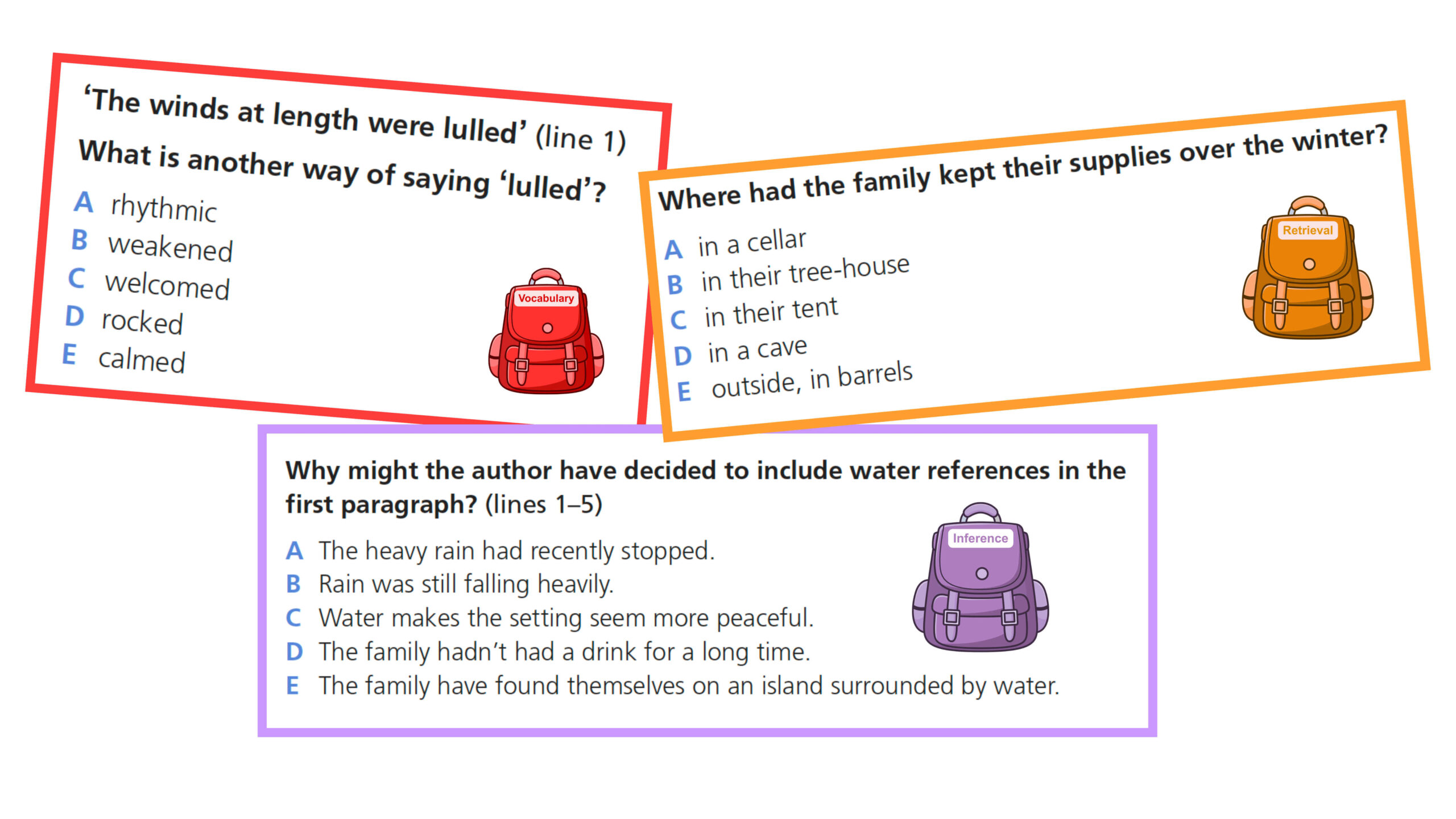
(Source: GL Assessment)
As seen in these GL Assessment sample questions, there are often several plausible answers. These distractors are carefully designed, and pupils must determine which option is the best answer rather than simply an acceptable one.
This requires analytical reasoning well beyond typical classroom comprehension tasks.
To approach these questions successfully, pupils should work methodically. They should read the full text before attempting the questions, twice if time allows. During preparation, children should be encouraged to refer back to the text for every question rather than relying on memory.
Using a process of elimination is particularly effective.
One important strategy to reinforce is to avoid becoming stuck on a single question. If unsure, pupils should mark it and return later. This protects both time and confidence.
When and How to Start Your Child’s 11+ Reading Comprehension Journey
There is ongoing debate about when 11+ preparation should begin, with opinions ranging from the early years to Year 5. Much depends on how “preparation” is defined.
Formal exam preparation differs significantly from building strong reading foundations.
As a qualified teacher and specialist English tutor, I encourage parents to begin informally as early as possible by:
- Reading frequently
- Reading a wide range of texts
- Discussing books regularly at home
This approach builds vocabulary, comprehension, and confidence over time. Research consistently shows that children who read widely develop stronger language skills more quickly than their peers, long before exam preparation begins.
How to Help a Child Struggling With 11+ Reading Comprehension
When children struggle with reading comprehension, the issue is often linked to gaps in foundational skills rather than a lack of ability.
These gaps may include:
- Weak phonics or decoding skills
- Limited understanding of morphology
- Insecure knowledge of syntax and grammar
Addressing these areas early is essential. Ideally, they should be targeted in Year 3 or 4, before formal 11+ preparation begins. One-to-one tuition can be particularly effective, as it allows teaching to be tailored precisely to a child’s needs.
Targeted Strategies to Improve 11+ Reading Comprehension Skills
If your child has strong foundations but needs to strengthen specific skills such as inference, vocabulary, retrieval, or explanation, there are practical steps you can take immediately.
These include:
- Using this diagnostic assessment to receive a breakdown of areas of strength and need
- Practising individual skills in isolation using educational games & activities
- Using guided reading resources and targeted vocabulary activities
- Encouraging regular independent reading at an appropriate level
Alongside this, it is beneficial to read a slightly more challenging text together each day and discuss it in depth. This combination supports both confidence and progress.
Key Reading Priorities in Year 5 for 11+ Success
By Year 5, pupils should have established secure reading foundations and can begin to develop analytical and critical thinking skills.
It is important to avoid excessive use of workbooks and practice papers. Overloading children too early can lead to fatigue and reduced focus later on.
In my Year 5 lessons, pupils complete a practice paper every six to eight weeks. This provides sufficient familiarity with the exam format while allowing time to address gaps in learning. More intensive work on timing and exam strategy is best left to the summer term.
Building an Effective 11+ Reading List to Tackle Weak Comprehension
Year 3 Independent Reading
Short Chapter Books
Accessible texts with manageable chapters and familiar themes.
- Flat Stanley by Jeff Brown
- The Owl Who Was Afraid of the Dark by Jill Tomlinson
- The Hundred-Mile-an-Hour Dog by Jeremy Strong
Adventure Classics
A step towards more demanding texts.
- Fantastic Mr Fox by Roald Dahl
- The Sheep-Pig (Babe) by Dick King-Smith
- The World According to Humphrey by Betty G. Birney
Year 3 Adult-guided Reading
Adult-guided reading allows children to access richer language and themes with support. These shared sessions develop vocabulary, inference, and discussion skills that underpin later 11+ comprehension.
- Charlotte’s Web – E.B. White
- The Reluctant Dragon – Kenneth Grahame
- Mrs Pepperpot Stories – Alf Proysen
- Winnie-the-Pooh – A.A. Milne
- Bronte Tempestra and the Lightning Steeds – Bex Hogan
- The Orchard Book of First Greek Myths – Saviour Pirotta
- Pippi Longstocking – Astrid Lindgren
Year 4: Independent Reading
By Year 4, many children can independently manage longer novels with more complex plots and vocabulary.
Core Year 4 Independent reads
- The Land of Roar – Jenny McLachlan
- How to Train Your Dragon – Cressida Cowell
- Varjak Paw – S.F. Said
Humorous and realistic fiction
- The Boy at the Back of the Class – Onjali Q. Raúf
- You’re a Bad Man, Mr Gum! – Andy Stanton
- Charlie and the Chocolate Factory – Roald Dahl
Shorter “bridge” chapter books
- The Hodgeheg – Dick King-Smith
- The Firework-Maker’s Daughter – Philip Pullman
Year 4: Adult-guided Reading
This stage is ideal for introducing classic texts with richer language, read aloud and discussed in depth.
- The Lion, the Witch and the Wardrobe – C.S. Lewis
- Alice’s Adventures in Wonderland – Lewis Carroll
- The Wind in the Willows – Kenneth Grahame
Year 5: Independent Reading
Core independent novels for Year 5 students
- The Wild Robot – Peter Brown
- Boy in the Tower – Polly Ho-Yen
- The Iron Man – Ted Hughes
Fantasy and adventure
- Dragon Rider – Cornelia Funke
- Harry Potter and the Philosopher’s Stone – J.K. Rowling
- The Last Bear – Hannah Gold
“Modern classic” style stories
- The Wolf Wilder – Katherine Rundell
- The Mouse and His Child – Russell Hoban
- The Scarecrow and His Servant – Philip Pullman
Year 5 “Greater Depth” Reading
- Wolf Brother – Michelle Paver
- The Kingdom Over the Sea – Zohra Nabi
- King of the Cloud Forests – Michael Morpurgo
Modern literary, character‑driven reads
- When Life Gives You Mangoes – Kereen Getten
- The Borrowers – Mary Norton
Classic / classic‑style stretch texts
- Tom’s Midnight Garden – Philippa Pearce
- The Hobbit – J.R.R. Tolkien
- Percy Jackson and the Lightning Thief – Rick Riordan
Best Books and Practice Papers for 11+ English Comprehension
There are many high-quality free resources available. The following have been carefully selected:
- Wordy Classroom Free 11 Plus English Resources
- For the most accurate free practice questions (depending on your target school):
- Wordwall 11+ Games
- Free 11+ Vocabulary Quizzes
- Atom Learning 11+ Free English Course
- Bond 11+ Free Materials
Practical Ways You Can Support 11+ English Comprehension at Home
Discuss character motivations and emotions in film and television.
- Why did they behave in that way?
- What does this reveal about their personality?
- How do we know how they are feeling?
Music: explore figurative language in songs.
- What does this line mean literally?
- Which technique is being used?
- Why has the writer chosen this image?
Reading for pleasure: talk about word choices and implied meaning.
- Which word stands out most?
- What does it suggest rather than state directly?
A Step‑by‑Step Approach to Preparing for 11+ Comprehension
- Identify gaps through a diagnostic assessment.
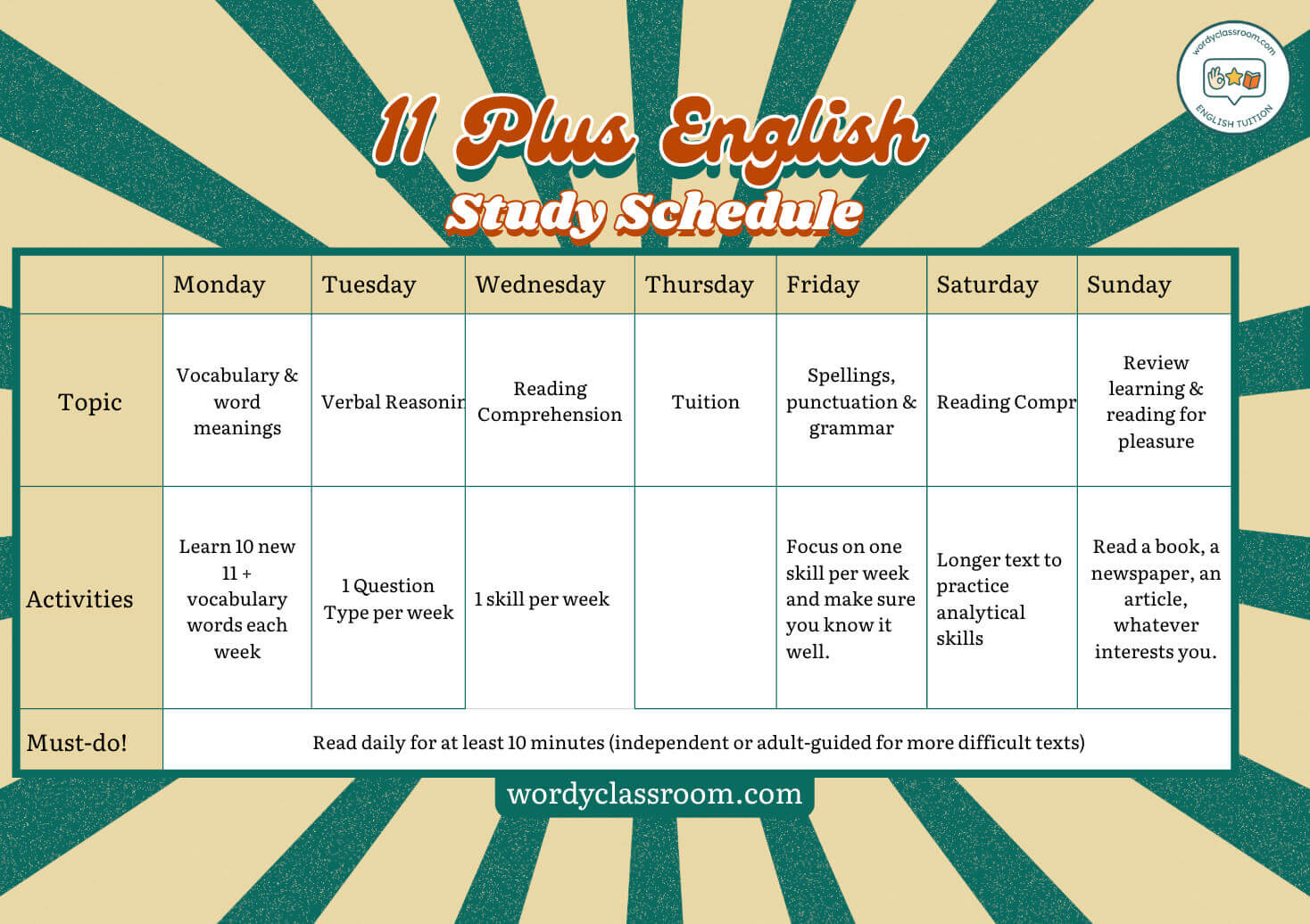
- Create a structured study plan, or download a ready-made example.
- In Year 5, complete a timed practice paper every six to eight weeks.
- In the summer term before exams, focus on exam strategy and timing.
This approach prioritises clarity, consistency, and confidence, supporting strong outcomes without unnecessary pressure.
Frequently asked questions
1. What exactly is 11+ reading comprehension?
It is an exam section where your child reads a passage and then answers questions that check how well they understand, interpret, and explain what they have read, usually within a strict time limit.
2. Which skills are actually being tested?
The exam looks at whether your child can pick out key facts, work out meanings of words, read between the lines, comment on language, and justify their views with evidence from the passage.
3. What kinds of texts can appear?
Children may face extracts from stories, biographies, factual articles, persuasive pieces, letters, diary entries or poems, so they must be ready for a range of styles and topics.
4. Are the questions multiple-choice or written answers?
Some exams use tick-box or multiple-choice formats, while others require full written sentences.
5. What are “retrieval” questions?
Retrieval questions ask your child to find information that is clearly stated in the text, such as names, dates or reasons, and copy or summarise it accurately.
6. What are “inference” questions?
Inference questions expect your child to use clues in the text to work out something that is not said directly, such as how a character feels or why they acted in a certain way.
7. What are vocabulary-in-context questions?
These questions give a word from the passage and ask for its meaning or a similar word, and your child must use the surrounding sentences to decide what the word means in that particular context.
8. How long does my child usually get for a comprehension?
Timing varies by exam board, but many papers give around 20–30 minutes for one passage and its questions, or longer if the comprehension is part of a full English paper.
9. Is spelling and handwriting marked?
In written-answer papers, marks can be lost if answers are unclear, incomplete, or full of errors, so neat handwriting and reasonably accurate spelling support your child in getting full credit.
10. My child struggles with long passages – what can I do?
Build reading stamina gradually with slightly shorter texts, then move to longer ones, always encouraging them to stay focused and chunk the passage into manageable sections.
Conclusion
11 Plus reading comprehension can be challenging, but with a strategic and systematic approach, it is entirely achievable. It is particularly helpful to begin with this diagnostic assessment and target weaker skills from there. If you have any questions or concerns about your child’s comprehension skills, please don’t hesitate to get in touch. I offer personalised support in a nurturing learning environment.