


One of the questions I’m asked most often is about what examiners expect in the 11 Plus (11+) creative writing task.
It’s a part of the exam that often feels mysterious – parents worry about “the right style” or “the perfect story.” But the truth is, examiners aren’t looking for perfection. They’re looking for clarity, imagination, and a sense that the child is thinking for themselves on the page.
That’s why I’ve put together this guide: to help you understand what schools are really looking for, and how you can gently support your child to grow in confidence and skill.
(Download my creative writing checklist here)
What Is the 11 Plus Creative Writing Task?
Creative Writing assessments are often included in many grammar and independent schools’ 11 plus English exams. Children are asked to plan and write a short piece: sometimes a story, sometimes a description, and occasionally a personal recount. The aim is to assess how well a student can organise ideas, use rich vocabulary, and control tone and structure under time pressure.
Common Types of Prompts
Each school or exam board may use slightly different tasks, but most creative writing prompts fall into a few main types:
- Continuation stories – children are given a short story opening or extract and asked to continue it in a similar style and tone.
- Visual or picture prompts – a single image is provided to inspire a description or narrative.
- Opening lines or scenarios – an intriguing first sentence such as “The door creaked open…” sparks a story idea.
- Descriptive or scene-setting tasks – students are asked to describe a place, event, or moment using vivid sensory details.
Whatever the prompt, success comes from balancing imagination with structure. I always encourage my students to plan briefly before writing, thinking about who, where, and what happens. Even a quick outline gives their story a clear shape.
Which Schools Test Creative Writing?
Not all 11 Plus exams include a creative writing task, so please make sure to check the details for each school. Here’s a simple breakdown of how the main exam boards and school types differ:
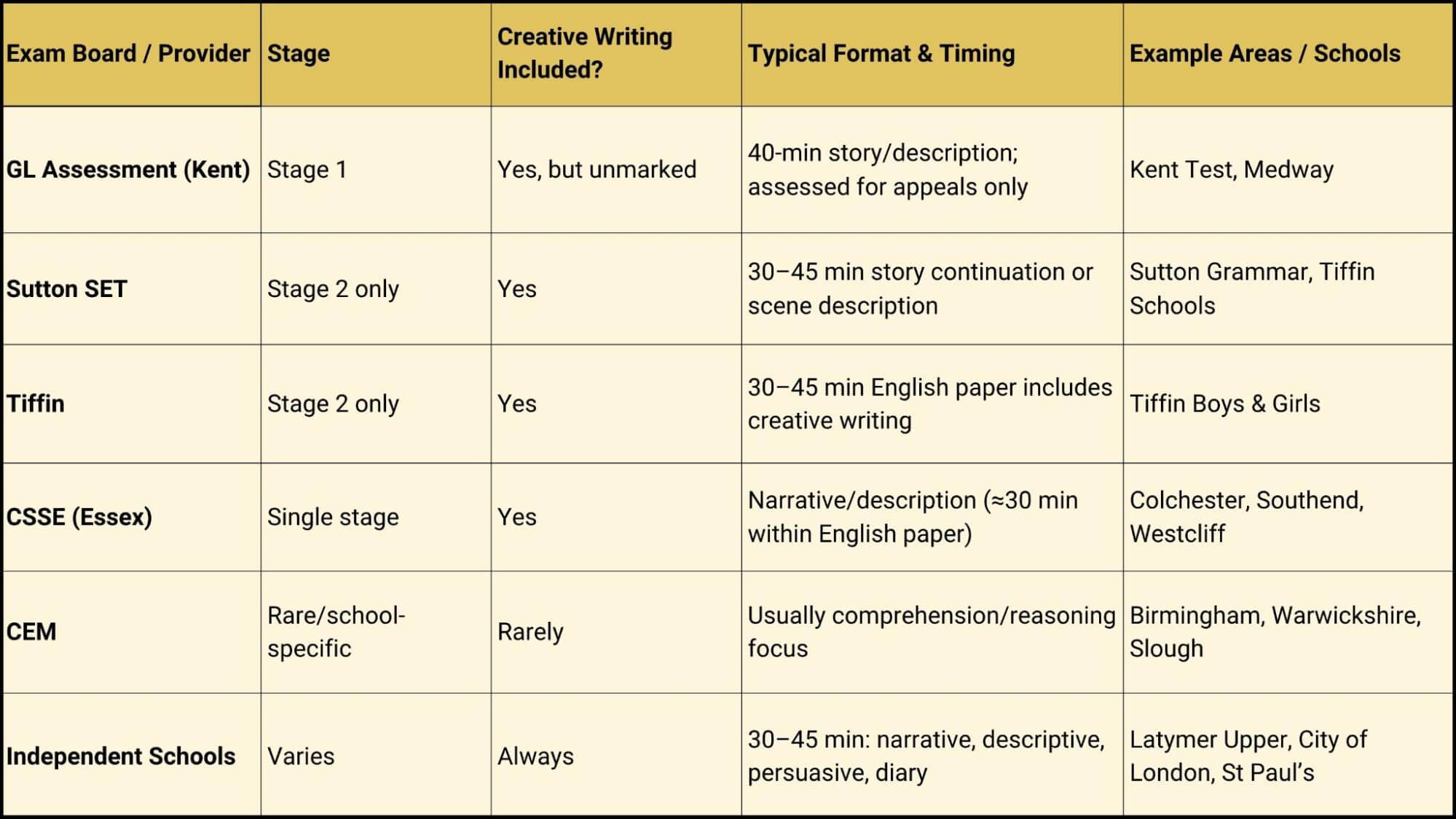
Tip for parents: Always check your target school’s admissions page, even within the same county, requirements can vary widely.
What Examiners Actually Look For in 11 Plus Creative Writing
Whilst there is often the notion that examiners mark creative writing based on their opinion alone, this is simply not the case. Examiners apply a clear, structured set of criteria, given to them by the exam board. Understanding what markers are looking for can really help students gain confidence in their writing.
Official Marking Criteria and Typical Weightings
The exact marking scheme varies by school and exam board. However most creative writing assessments use a two-part breakdown: one assessing content and style, the other assessing technical accuracy (spelling, punctuation, grammar).
Here’s a typical range of assessment elements and weightings:
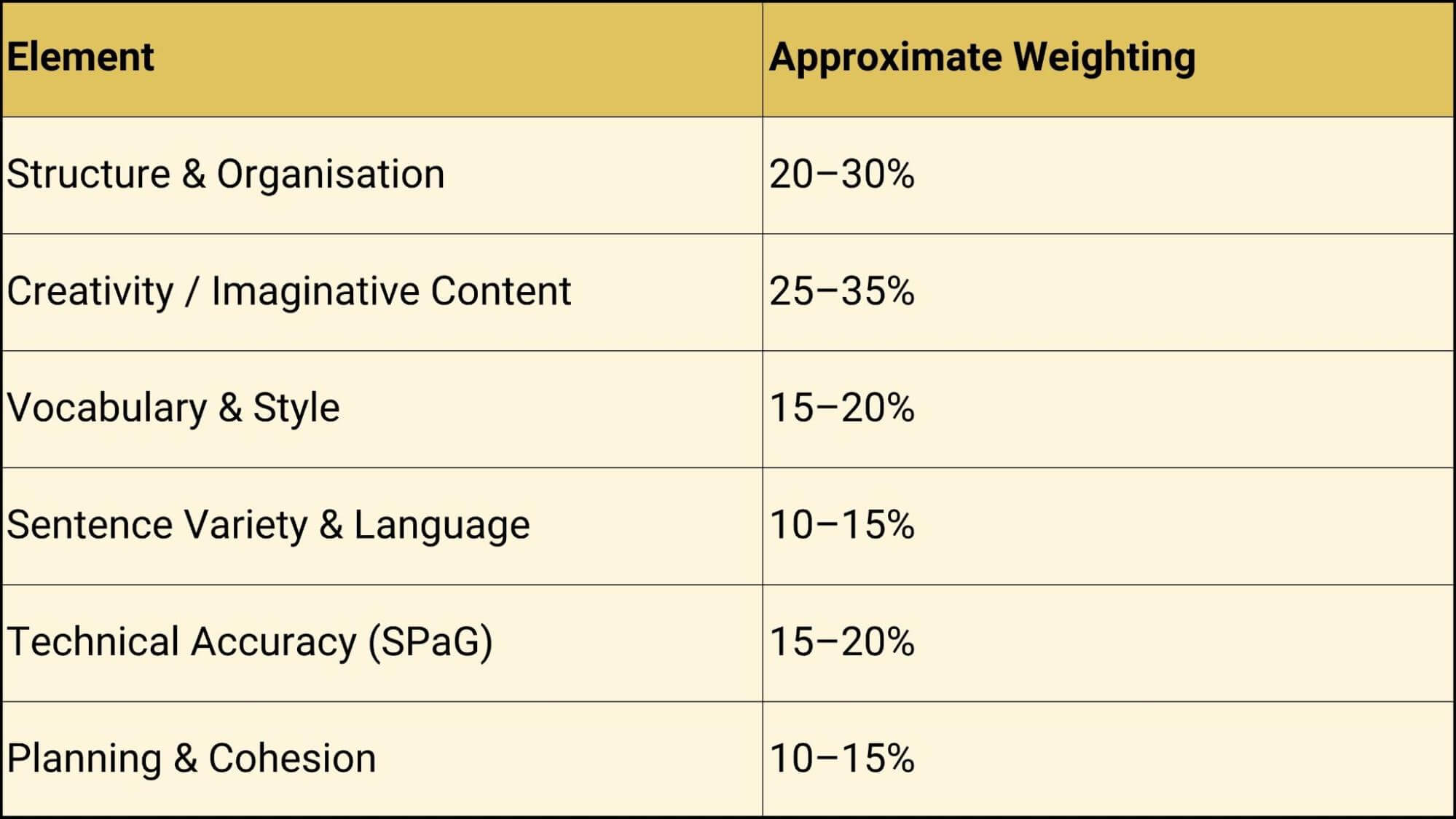
Use these weightings for guidance in preparation. For exact scores, always check the target school’s details.
The Six Essential Elements Examiners Want to See
In nearly all marking schemes, these six areas are prioritised:
- Vocabulary: Is there a wide range of words, used accurately and effectively?
- Punctuation & Grammar (SPaG): Sentences should be clear, tenses consistent, punctuation accurate, and spelling correct.
- Structure & Organisation: The writing needs a clear beginning, middle, and end, with logical paragraphing and a coherent narrative.
- Creativity / Imaginative Content: Does the piece answer the prompt with original ideas, vivid description, interesting characters or a gripping plot?
- Planning: Even brief planning shows in smoother endings and less rambling, helping writing feel purposeful.
- Sentence Variety & Style: Are there short and long sentences, dialogue, figurative language, and descriptive detail to make the piece engaging?
Common Mistakes That Lose Marks
Examiners consistently penalise for:
- Unclear structure or no resolution: Stories that simply stop or use endings like “and then I woke up.”
- Over-ambitious plot: Too many characters, settings or events, giving each one superficial attention.
- Repetitive basic vocabulary: Overusing words like “nice” or “went” instead of richer, precise choices.
- SPaG errors: Inconsistent tenses, missing punctuation, and correctable spelling mistakes.
- Telling rather than showing emotion: “I was sad” versus “My heart sank as the door slammed behind me.”
- Lack of paragraphing: A single block of text without breaks makes writing harder to read and less mature.
Why “Show-Don’t-Tell” Matters for Top Marks
“Show-don’t-tell” is one of the best techniques that children can have in their toolbox for creative writing. Instead of stating facts or emotions, students should demonstrate feelings, actions, and settings to bring the story alive. For example, instead of telling the reader ‘I was frightened’ show them by saying ‘My chest tightened as I crept into the dark corridor.’
Examiners reward:
- Control of language and detail
- Vivid sensory description, varied vocabulary, and well-structured narrative
- Engagement, drawing the examiner into the world of the story
- Evidence of deeper thought about character, setting, and mood
During writing practice, encourage students to find “telling” sentences in their drafts and challenge them to “show” the moment or feeling instead. This process can lift a competent piece into the top-scoring band.
Key Differences Between Independent and Grammar Schools
Independent Schools
Expect higher literary skill, mature vocabulary and emotional depth. Originality and flair are rewarded generously. Prompts are often more abstract, and writing must show deliberate control of tone, atmosphere and rhythm.
Grammar Schools
Focus on technical precision, clear structure and relevance to the prompt. Examiners value correctness and cohesion more than decorative language.
Across all schools, top-scoring pieces share the same foundation: clarity, planning and purpose. A story with a clear beginning, middle and end, consistent tense, accurate punctuation and varied sentence styles will always impress.
Tutor’s note:
If your child is preparing for an independent school, practise ambitious, well-structured stories with rich sensory detail and thoughtful vocabulary.
For grammar school 11+, focus on clear organisation, accuracy and concise storytelling. Short, strong and polished work will always beat something long and rushed.
If you’re looking for personalised guidance in any of these areas, I offer one-to-one tutoring to help your child write with clarity, confidence, and style.
Summary Table

Creative Writing Model Sample Answers
Narrative Writing
Prompt: “The door slowly creaked open…”
Foolish Fright
The door slowly creaked open and a gust of cold air brushed against my face. I hesitated, my hand still clutching the torch that flickered in the darkness. The hallway beyond looked as though no one had walked there for years; dust floated in the torchlight like tiny ghosts.
Taking a deep breath, I stepped inside. The air smelt of damp wood and something metallic. My shoes left faint prints on the thick layer of dust. At the end of the corridor, a picture hung crookedly on the wall- a woman with kind eyes and a faint smile. I felt as though she was watching me.
A sudden crash echoed from upstairs. My heart thumped wildly as I froze. For a moment, I wanted to run, but curiosity held me still. Slowly, I climbed the staircase, each step groaning under my weight. When I reached the landing, I saw the source of the noise: a small window banging in the wind. I laughed quietly, feeling both foolish and relieved.
As I turned to leave, the torch flickered once more. That was when I saw it: the picture of the woman had fallen to the floor. Her faint smile was gone.
Why This Scores Highly
- Structure: Clear beginning, build-up, climax, and ending.
- Sentence Variety: Mix of short, punchy sentences (“I hesitated.” “I laughed quietly.”) and longer descriptive ones for rhythm.
- Vocabulary: Sophisticated but natural (e.g., “metallic,” “crooked,” “groaning,” “relieved”).
- Literary Devices: Personification (“dust floated… like tiny ghosts”), sensory detail (sight, smell, touch).
- Ending: Ambiguous yet satisfying; it lingers in the reader’s mind.
Techniques Breakdown

Descriptive Writing
Prompt: “Describe an abandoned lighthouse.”
The Hollow Tower
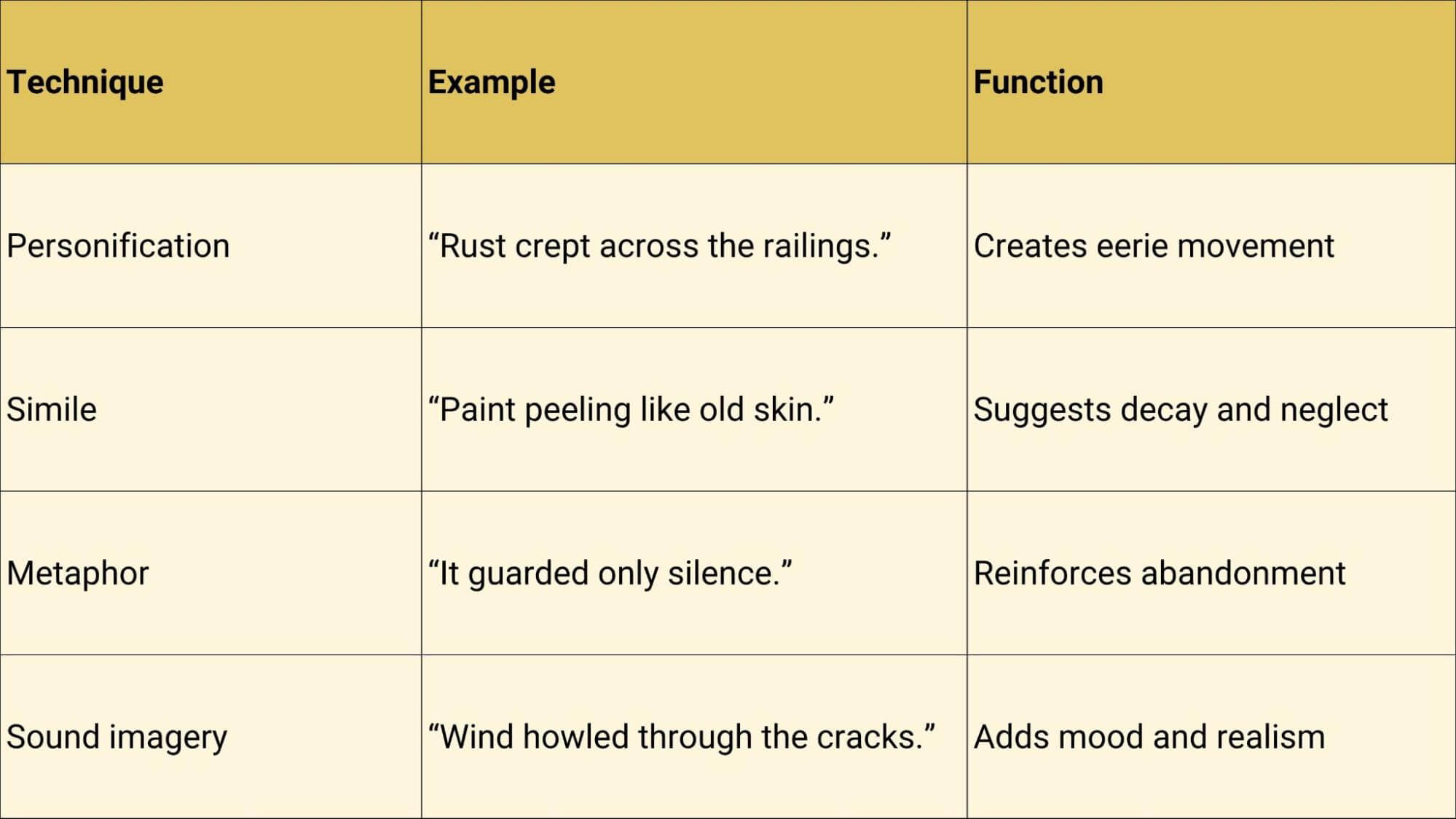
The lighthouse stood alone on the cliff, its white paint peeling like old skin. The sea below roared and crashed against the rocks, spraying mist into the salty air. Broken glass glittered in the doorway, and gulls circled overhead, crying like restless ghosts.
Inside, the air was cold and heavy. Rust crept across the railings, and every footstep echoed through the hollow tower. A faded map clung to the wall, its edges curled and torn. Once, this place must have guided sailors home; now it guarded only silence.
As I climbed the spiral staircase, the wind howled through the cracks, whispering secrets of storms long gone. At the top, the lantern room was empty. The great lamp that had once burned proudly was nothing more than a cracked shell. Outside, the horizon stretched endless and grey, and for a moment, the world felt utterly still.
Why It Scores Full Marks
- Multi-sensory description (sound, sight, smell, touch).
- Controlled tone and consistent mood of decay and loneliness.
- Advanced vocabulary used naturally (“hollow tower,” “curling map,” “rust crept”).
- Figurative language supports atmosphere, not decoration.
Descriptive Techniques Used
Character-Based Writing
Prompt: “Write about a character facing a challenge.”
You Can Do This
Lena stared at the diving board. Ten metres looked easy from the ground, but now, with the pool glinting far below, her knees began to shake. “You can do this,” she whispered, though her voice trembled.
The line behind her grew longer. A few children snickered. For a second, Lena thought about climbing down, pretending she’d changed her mind. Then she remembered last week, watching her younger brother dive without fear. She had promised herself she would be brave too.
She closed her eyes, took one deep breath, and stepped forward. For a heartbeat, the world held its breath with her. Then she jumped. The rush of air filled her ears. The water rose up, cold and clean, wrapping her in a shock of silence.
When she surfaced, gasping, she was laughing. The fear was gone, replaced by something stronger: pride.
Why This Scores Highly
- Clear emotional arc (fear → decision → action → release).
- “Show, don’t tell” used effectively (“knees began to shake” instead of “she was scared”).
- Concise but powerful imagery.
- Builds empathy and momentum.
Picture Prompt
Prompt: “visual prompt.”

Majestic Forest
Mist hung between the trees like breath on glass. Every branch dripped with silver dew. Somewhere ahead, a faint trail wound deeper into the forest. I followed it, though the silence felt too thick, too heavy.
A bird cried once, then stopped. The air seemed to hold its breath. That was when I saw the footprints- small, barefoot, fresh. My pulse quickened. Whoever they belonged to could not be far away.
I pushed aside a curtain of ferns and froze. A wooden door stood in the trunk of an enormous oak. Its handle was carved from bone. Slowly, I reached out my hand. The bone handle felt cold beneath my fingers. I hesitated, glancing at the footprints again – they led straight to this door. The silence pressed in, but curiosity won. I pulled gently, and the door swung open with a low groan.
Inside, the space was dim, lit only by streaks of morning sunlight filtering through cracks in the bark. A small bundle of blankets lay in the corner. Suddenly, a face appeared, peering from the shadows- a child, barefoot and wide-eyed, watching me with cautious hope.
For a moment, neither of us moved. The forest outside seemed a world away. I swallowed, unsure whether to speak or step back. But something in the child’s gaze- lonely, expectant, brave- kept me standing where I was, waiting for the story beyond the door to begin.
Why This Works
- Begins with sensory description, then builds tension.
- Keeps focus on a single, vivid image (the door).
- Ends on a cliff-hanger, ideal for time-limited writing.
- Clear paragraph breaks guide pacing.
What Not to Do
- Don’t describe everything in the picture. Focus on one detail that tells the story.
- Avoid overloading adjectives (“dark, creepy, spooky, scary forest”).
- Don’t forget an ending, even a short twist makes it satisfying.
Key Techniques
- Vary sentence lengths to control pace.
- Use one dominant mood throughout.
- Show the setting through movement (“I pushed aside a curtain of ferns”).
Opening Line Continuation
Prompt: “I knew I was in trouble when…”
Accidents Happen
I knew I was in trouble when I heard my name echo across the hall. Mum’s voice was sharp, certain, impossible to ignore. I froze halfway up the stairs, my muddy trainers leaving perfect prints on the carpet.
“Liam!” she called again. I glanced down at the football still rolling gently against the broken vase. My stomach twisted. There was no way to fix this.
When she appeared at the bottom of the stairs, I started talking too fast, too loudly, explaining, apologising, inventing reasons. She didn’t say a word. She just picked up the football, turned it over in her hands, and smiled. That was worse than shouting.
Mum’s smile lingered, even as she swept up the pieces of the vase. I babbled about the slippery grass and tried to promise I’d be more careful next time. She simply handed me a cloth. “Accidents happen, Liam. But muddy shoes and broken vases? That’s two chores for you.”
Relief mixed with embarrassment as I knelt by the carpet, scrubbing at the muddy prints. While I worked, Mum started to hum quietly and dusted the hall. When I looked up, the football was sitting on the stairs, and the hallway was nearly spotless once more.
As she walked past, Mum ruffled my hair. I grinned, suddenly feeling lighter. Maybe, I thought, being in trouble wasn’t always the worst thing- especially when Mum was there to help me put things right.
Why It Works
- Tight structure: beginning (problem), middle (reaction), end (quiet resolution).
- Builds tension through short sentences and pacing.
- Realistic dialogue and sensory cues.
- Finishes with emotional subtlety rather than drama.
Pacing Techniques
- Short paragraphs speed up tension.
- Single-sentence lines can emphasise key moments.
- Keep one clear conflict, resolved or hinted at by the end.
30+ Practice Prompts from Real Past Papers
One of the best ways to prepare for the 11 Plus creative writing exam is to practise with real prompts. Many schools reuse familiar themes such as weather, emotion, settings, or objects. Many prompts, such as “The old key” or “A stormy night,” have been featured in 11 Plus practice sets and past papers. So, practising across these categories builds both confidence and adaptability.
Below you’ll find over 30 curated prompts, grouped by theme and difficulty level. I’ve also included examples of schools or exam boards that have used similar tasks where known.
Weather-Based Prompts
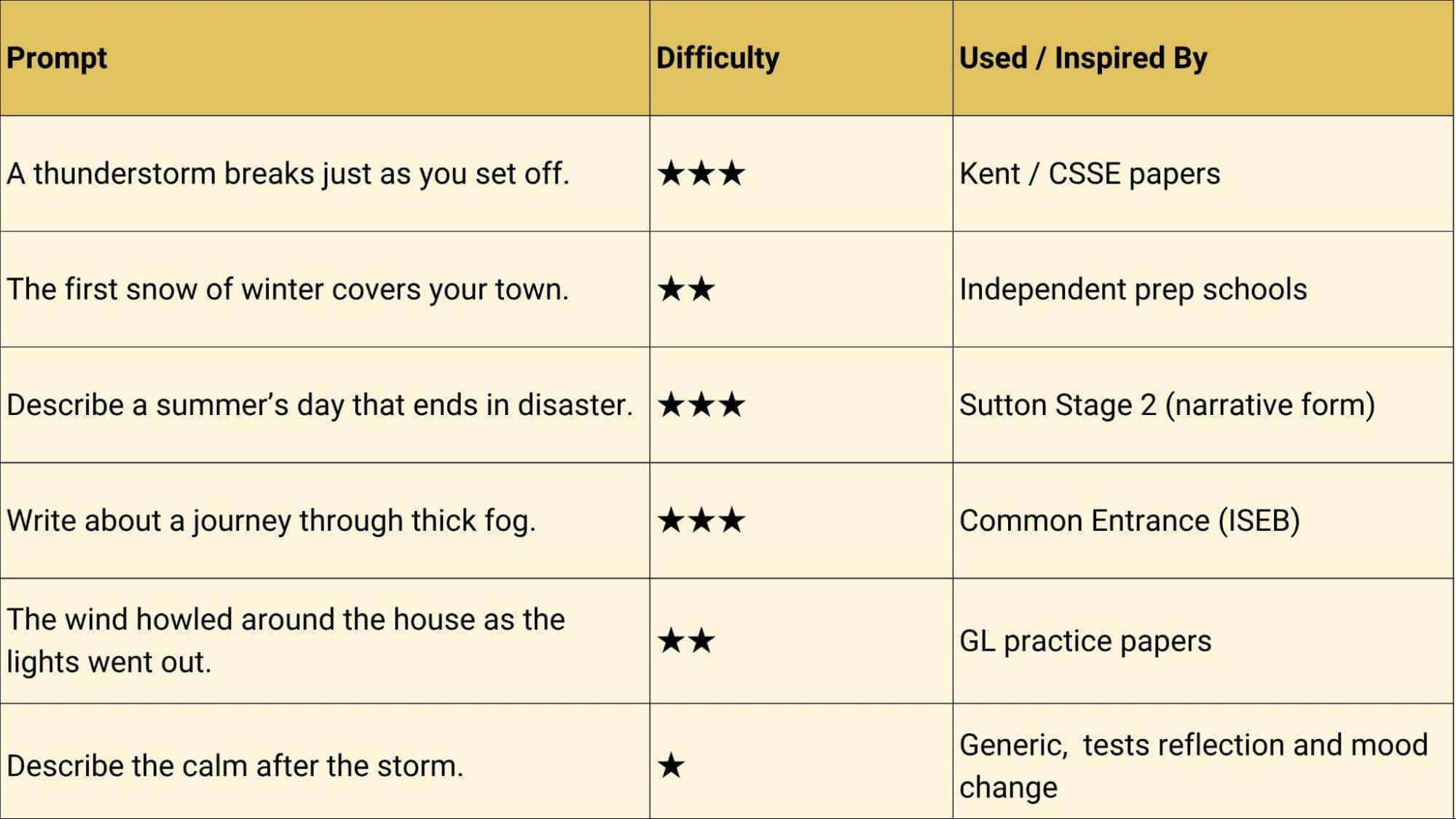
Tutor Tip: Weather is rarely the “main character.” Encourage your child to use it to reflect emotion or build tension rather than fill the page with description.
Location-Based Prompts

Tutor Tip: Settings are most effective when they reflect the character’s state of mind, use sensory details, not just visual description.
Emotion-Based Prompts
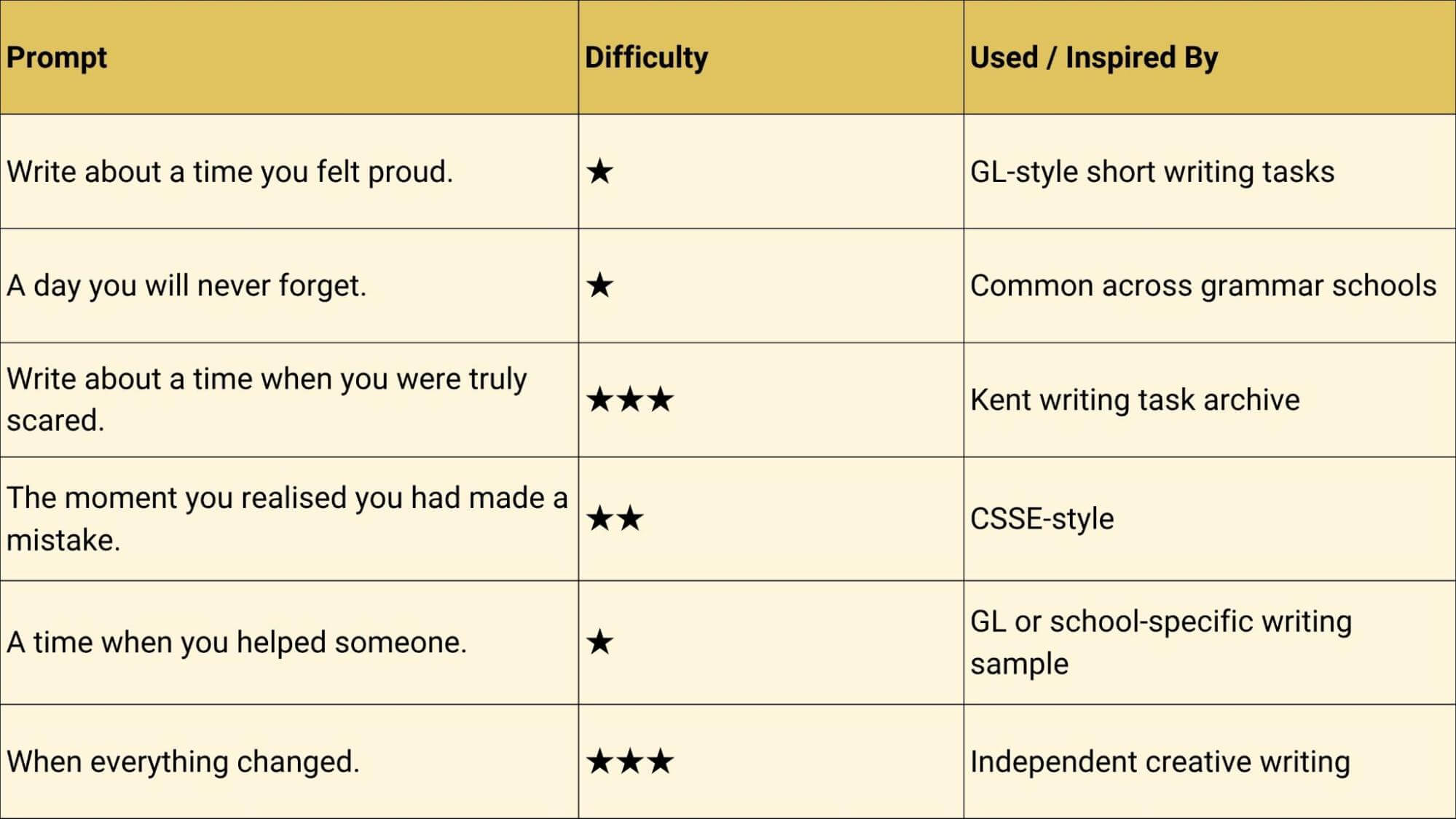
Tutor Tip: These prompts reward honest, personal tone. Examiners love emotional control more than drama, subtle reflection is stronger than exaggeration.
Object-Based Prompts
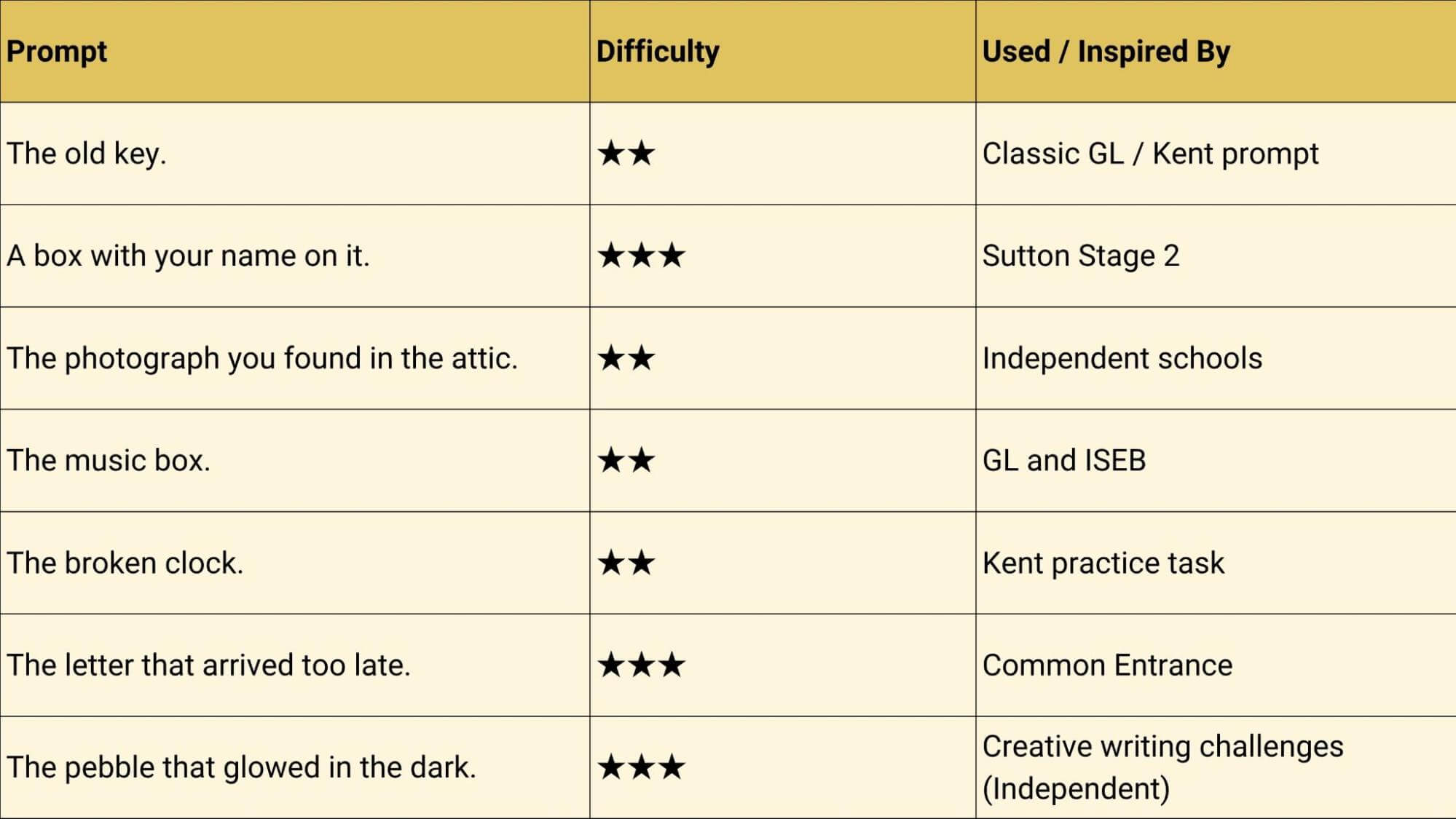
Tutor Tip: For object prompts, start by asking “Who does it belong to?” or “What secret does it hold?” This creates instant narrative direction.
Mixed / Advanced Prompts
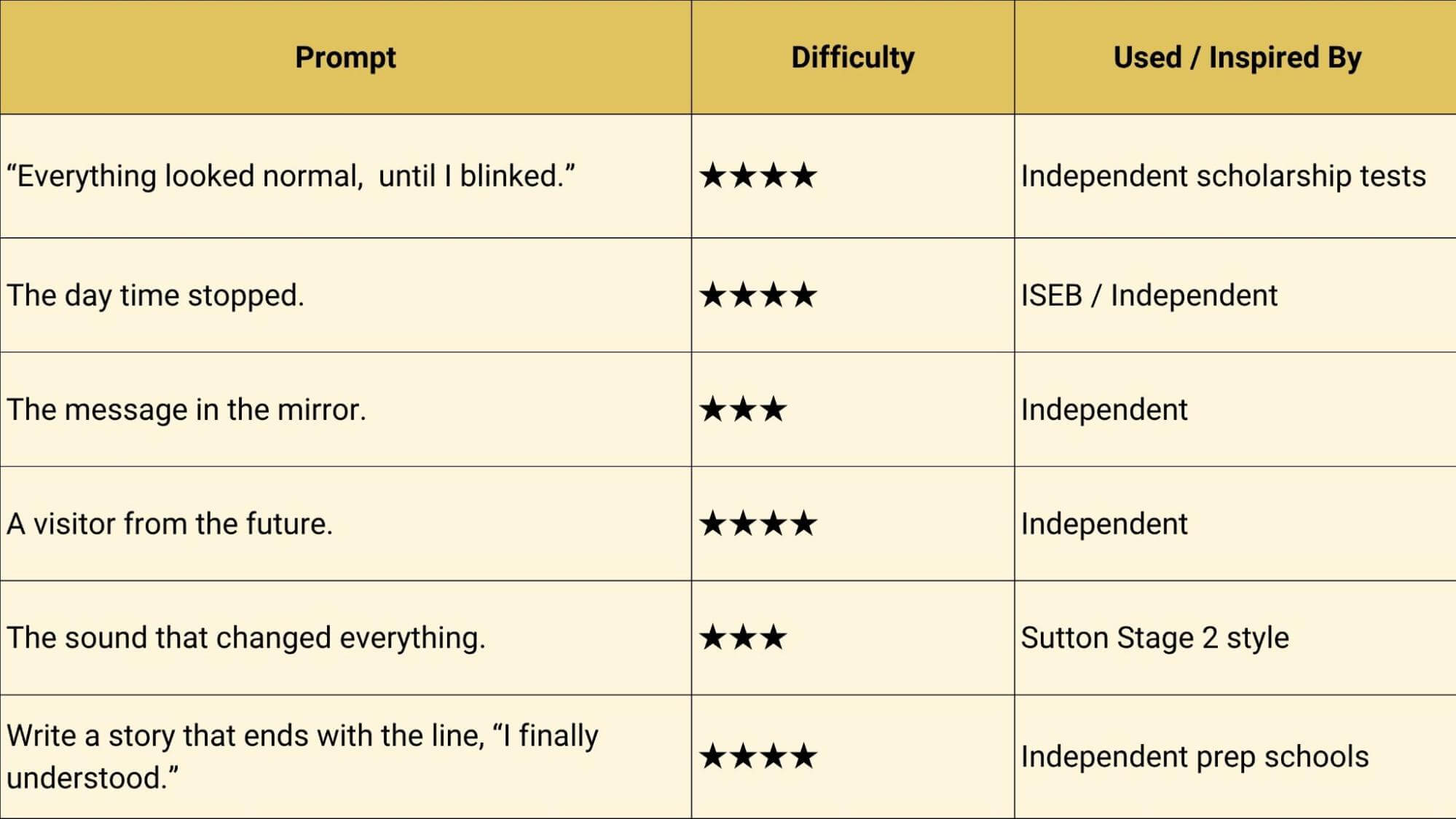
Tutor Tip: For advanced writers, focus on story control, a single idea developed fully will always outperform a story that tries to do too much.
Essential Writing Techniques with Mini-Examples
Often children are told to use ambitious vocabulary, but aren’t shown how to do this effectively. Strong writing isn’t just about using big words, it’s about using the right ones, in the right way.
Show, Don’t Tell Technique
We hear this term a lot in the world of creative writing. But how can children apply it? Examiners reward stories that use physical reactions, sensory cues, and body language to reveal emotion.
Before and After Examples
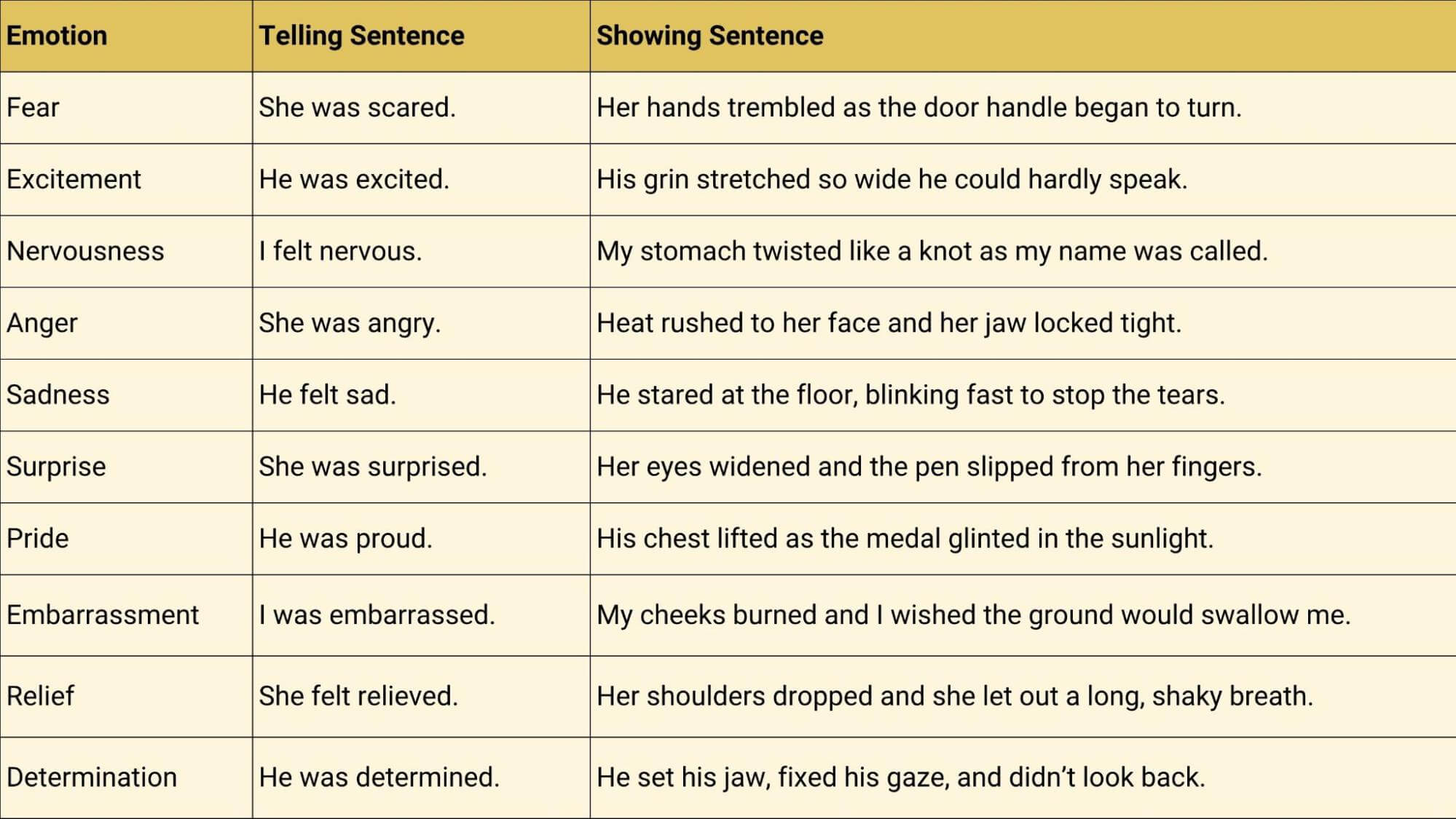
Tutor Tip: Ask your child to underline any “telling” sentences in their drafts and replace them with actions, dialogue, or physical reactions. This instantly makes their writing feel more mature and expressive.
Powerful Vocabulary Banks
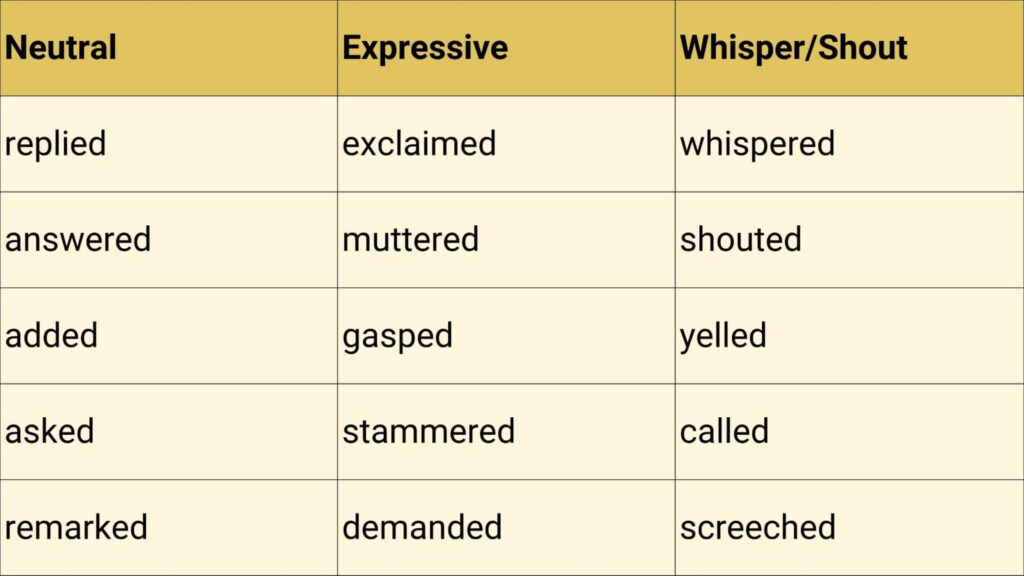
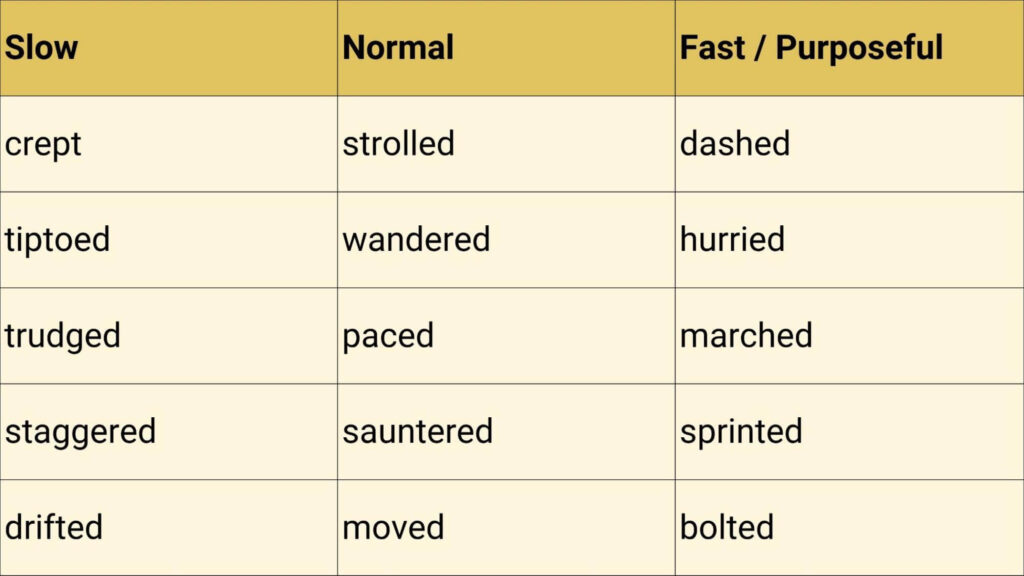
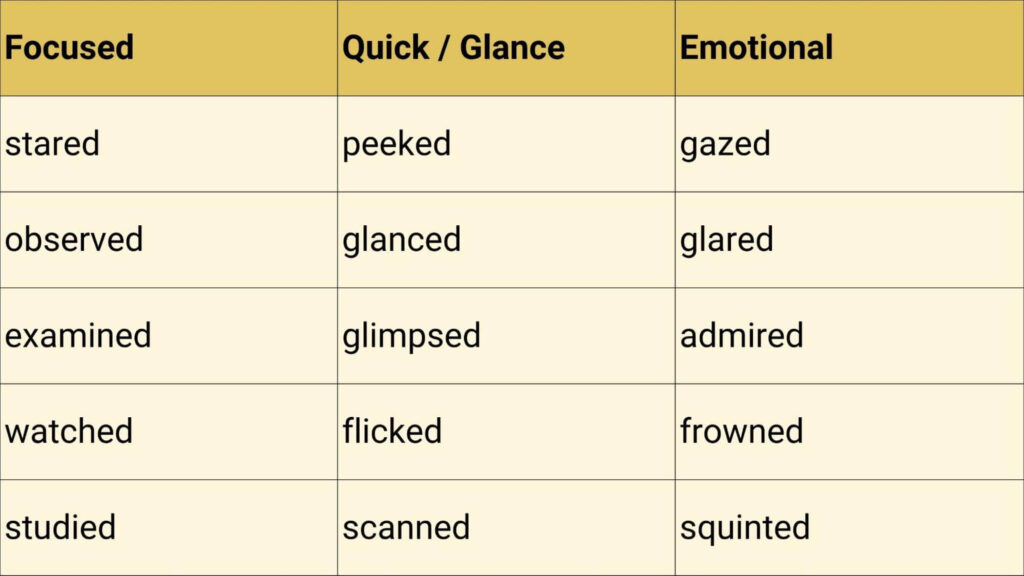
A rich vocabulary helps stories feel alive, but children shouldn’t force complicated words that don’t fit the tone. Encourage them to learn versatile, precise alternatives and sensory language.
1. Alternatives for “Said”
2. Alternatives for “Walked”
3. Alternatives for “Looked”
4. Sensory Vocabulary

Tutor Tip: Create a personal “word bank” for each child and encourage them to keep adding new favourites. Review and reuse those words in future stories.
Literary Devices Made Simple
Examiners love to see literary devices used naturally and purposefully. Here’s how to teach them simply, with examples that suit the 11 Plus level.
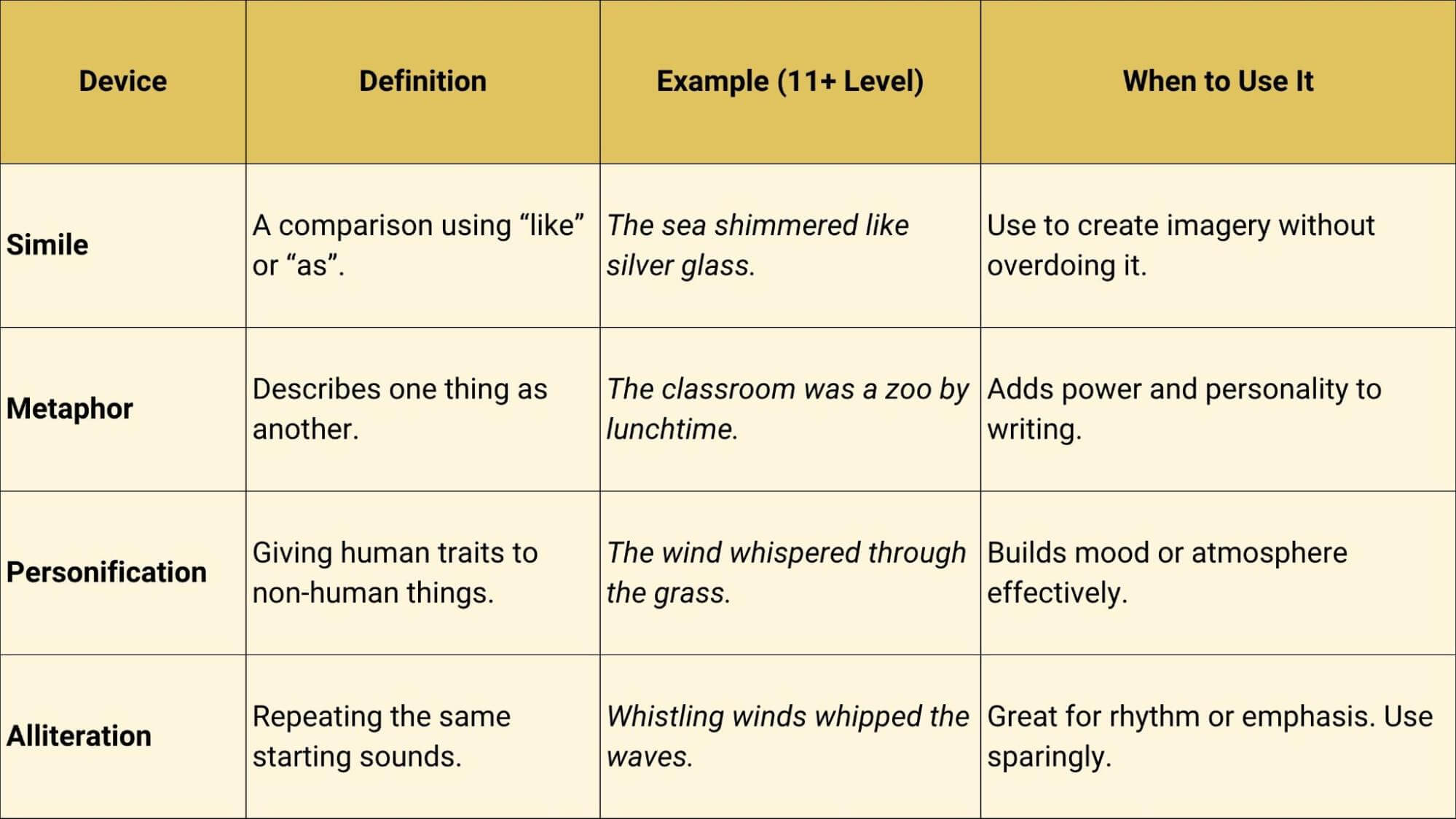
When Not to Use Them
- Avoid stacking several devices in one sentence (“The dark night was as black as coal, whispering wildly…”).
- Don’t use unfamiliar metaphors that distract from meaning.
- Try not to use clichéd similes and metaphors e.g. “She’s as quiet as a mouse.”
- Keep language simple enough that it feels natural for the story.
Tutor’s note: Encourage students to practise one technique at a time. For example, have them rewrite a short paragraph focusing only on “show, don’t tell,” or using three different sentence openers. Small, focused practice builds genuine skill and confidence over time.
Frequently Asked Questions
Is creative writing included in stage 1 or stage 2 of the 11 plus exam?
In most selective grammar schools (such as Tiffin or Sutton) creative writing appears in Stage 2 (the second round).
The GL Assessment Kent Test includes a short writing task in Stage 1, but it’s only reviewed if a child is close to the pass mark or during appeals.
Independent and prep schools set their own rules. Some weave creative writing into broader assessment days, where it’s used to explore imagination, reasoning, and communication skills together.
So yes, creative writing appears in both stages, but how it’s marked depends entirely on the school’s approach.
The safest path? Prepare for both- calmly and confidently.
What if my child’s writing style is different from the examples?
That’s more than fine- wonderful, even.
Every child carries a rhythm that’s uniquely theirs. Examiners notice when writing feels authentic, not rehearsed.
A quiet, reflective story can move a reader just as deeply as a dramatic one- when it’s organised, accurate, and thoughtful. The goal isn’t sameness; it’s self-expression with structure.
As a tutor, I remind parents often: we’re not shaping “perfect” writers. We’re helping young voices find clarity, confidence, and joy in their own words.
Start where they are. Grow from there.
Can creative writing be taught, or is it natural talent?
Creative writing isn’t a gift reserved for a few- it’s a skill that blossoms with guidance and practice. Some children seem naturally imaginative, yes. But imagination alone needs scaffolding: structure, vocabulary, and planning all come with time and teaching.
Through short, consistent writing bursts (even 10–15 minutes), regular feedback, and exposure to strong stories, every child can learn to build worlds with words.
Talent may open the door- but practice, reading, and reflection help them walk through it with confidence.
Every storyteller begins somewhere. Practice makes their voice stronger.
How much does creative writing count toward the overall 11+ score?
It depends on the school.
Grammar Schools: Many use multiple-choice English papers, so the creative writing task might not be formally marked. In some regions (like Kent), it’s reviewed during appeals or to distinguish candidates near the borderline. Where it’s included, writing can account for roughly 25–50% of the English paper.
Independent Schools: Here, creative writing holds more weight- often 30–40% of the total English score. It’s also central to scholarship assessments and identifying higher-level ability.
Even when it’s not graded, writing matters. It strengthens comprehension, vocabulary, and confidence- the quiet foundations behind every strong 11+ performance.
Final Thoughts
Creative writing isn’t just about exams- it’s about helping children find their voice.
Through storytelling, children learn skills that last far beyond any test: empathy, clarity, and imagination. These are the foundations of confident communication.
If you feel your child could benefit from gentle guidance and practice in creative writing, reach out, I’d love to help.
Start where they are. Grow from there.