Almost every 11+ parent I work with asks me the same question: "How can I improve my child's vocabulary for the 11+?"
It is an area of the 11+ that deserves its own article, so here is my attempt: a practical guide to 11+ vocabulary that you can actually use at home straight away.
I have gathered all of the research I have done over the years, my own experience from tutoring, as well as insights from the students themselves. I have aimed to present the information in such a way that you can begin to apply the strategies at home immediately, without getting lost in endless word lists.
Why 11+ Vocabulary Matters So Much
Vocabulary is absolutely central to the 11+. It shows up in obvious places (synonym/antonym questions, cloze tasks) and in less obvious ones (comprehension, creative writing and verbal reasoning).
If your child cannot confidently understand the words in the text, the question stem and the answer options, they will always be working at a disadvantage. A strong 11+ vocabulary, built mainly through wide, challenging reading, allows them to show what they can really do, rather than being tripped up by the language of the paper itself.
There is no magic number of words your child "must" know for the 11+, and no school publishes an official list. Most commercial 11+ vocabulary lists hover around a few hundred "high-yield" words, but depth of understanding matters more than raw quantity. I would rather a child truly own 150–200 rich, exam-relevant words (able to recognise them, define them in their own words, use them in a sentence and spot synonyms/antonyms) than rattle through 800 words they have seen once and instantly forgotten.
Building 11+ Vocabulary Through Reading

From the grammar and independent schools themselves:
"The tests identify boys who enjoy and are confident in reading and writing."
— Tiffin Boys'
"The tests will identify children who enjoy and are adept at reading, writing, thinking creatively, working with numbers, and problem-solving."
— Tiffin Girls'
Students should "Develop strong reading habits by reading widely and deeply."
— CCHS
"Develop their love of literature through widespread reading for enjoyment."
— Reading School
"They are encouraged to read widely and engage in activities that inspire curiosity for the wider world."
— Forest School
"It will be a piece of children's literature which may well be known to them if they have read widely."
— The Kimbolton School
Students who are habitual readers acquire new vocabulary naturally. Researchers believe that through incidental vocabulary learning, learners can gain deeper, more pragmatic knowledge of words, such as connotation and collocation, and can recognise patterns in where the words are used (Wolter & Helms-Park, 2015). This suggests that reading widely and deeply makes vocabulary acquisition more meaningful.
Additionally, reading a more challenging text with your child can expose them to a wider variety of vocabulary that appears in 11+ English exams. For recommendations, read my article on 11+ Reading Comprehension, where I suggest books that stretch children just beyond their comfort zone.
Using Context Clues to Improve 11+ Vocabulary
This one is sung from the rooftops of every social media platform I frequent, and there is a good reason.
How Context Clues Work in 11+ Vocabulary
Context clues are hints in the surrounding sentence, paragraph or wider text that help your child work out the meaning of an unfamiliar word without using a dictionary.
First of all, learning vocabulary in context is the most powerful way to acquire new words. Additionally, learning how to infer the meaning of unknown vocabulary in context is a valuable reading comprehension skill in the 11+. Guessing word meaning, or lexical inferencing, is required not only for incidental vocabulary learning (Nation, 2013) but also for reading comprehension (Zhang & Koda, 2012). Because of this, inferring the meaning of unknown vocabulary is a highly beneficial learning method.
As Forest School says:
"Candidates should not be thrown by vocabulary they do not know, as one of the things we are assessing is the ability to infer meaning from context."
— Forest School
In other words, the exam is not just checking "do you know this word?" but "can you work it out?"
A Classic Example of Context Clues
Clues in the sentence, paragraph and overall text can indicate the meaning of a word. Let's take this example from Animal Farm:
"At one end of the big barn, on a sort of raised platform, Major was already ensconced on his bed of straw, under a lantern which hung from a beam. He was twelve years old and had lately grown rather stout, but he was still a majestic-looking pig, with a wise and benevolent appearance in spite of the fact that his tushes had never been cut. Before long, the other animals began to arrive and make themselves comfortable after their different fashions."
If your child had never encountered the word "ensconced" before reading this text, they might be able to infer its meaning based on the clues surrounding it. For instance, the other animals begin to arrive and "make themselves comfortable". We can therefore infer that Major has settled himself on his bed.
You can model this kind of thinking aloud when reading with your child:
- "What's happening in this sentence?"
- "Is there an example, a definition, a similar word or a contrast?"
- "What does 'ensconced' probably mean here, given that everyone is getting comfortable?"
That habit of looking around the word is a powerful exam skill.
Types of Context Clues (With 11+ Examples)
There are several different types of context clues which can support a child's understanding of vocabulary:
- Example clues: where the author gives examples of the word. The bazaar was full of spices, teas and an assortment of ornaments.
- Definition clues: a literal definition can be found in the surrounding text. The tundra, a vast, treeless plain, stretched out before them.
- Synonym clues: a nearby word has a similar meaning. The boy was ecstatic when he heard the news. He knew his mum would be overjoyed too.
- Antonym clues: a nearby word has the opposite meaning. Unlike his gregarious brother, Tom was rather quiet.
Morphological Awareness: Breaking Words Apart
Morphology, or morphological awareness, is the ability to recognise the smallest parts of words (morphemes) that still have meaning. This is another huge lever for 11+ vocabulary and verbal reasoning.
Let's take the word incomprehensible. It can be broken down into its:
- Prefix: in (meaning not)
- Root: comprehend
- Suffix: ible (meaning able to be)
Now the word incomprehensible is a lot less scary, and we can deduce that it means "not able to be understood".
Having a robust knowledge of the most common prefixes, suffixes and root words can give children greater confidence in decoding unknown vocabulary, an essential skill for 11+ verbal reasoning and 11+ reading comprehension. In fact, if a child learns a relatively small bank of high-frequency morphemes, they will be able to decode hundreds of complex words that appear in 11+ papers.
Using Prefixes, Suffixes and Roots at Home
For tracking new vocabulary, download my free vocabulary tracker and use the Morpheme Mapper to break the words down. Using the Online Etymology Dictionary to research the root and link it to related words is another constructive learning activity.
Research by Devonshire, Morris and Fluck (2013) highlights the impact of explicit literacy interventions that focus on word origins and structure. By teaching children to identify shared morphemes (such as the Latin root dict, meaning "to say", found in predict, dictate and contradict), students demonstrated notable progress in their overall reading and spelling abilities.
Choose a small set of common morphemes and come back to them repeatedly, rather than trying to memorise everything at once. When a new word appears in reading, ask:
- "Can we see any bits of this word we recognise?"
- "Does it remind us of another word we already know?"
- "What might the whole word mean if we put those parts together?"
You can turn this into an exploratory activity by making "word families". Children often enjoy noticing that a root like port turns up in portable, transport and export. The goal is to make word structure feel like a puzzle.
When Morphology Doesn't Quite Work
It is important to note that it is not always possible to break words down into their morphemes, as many English words seen in classic children's literature are archaic or adopted from the French language.
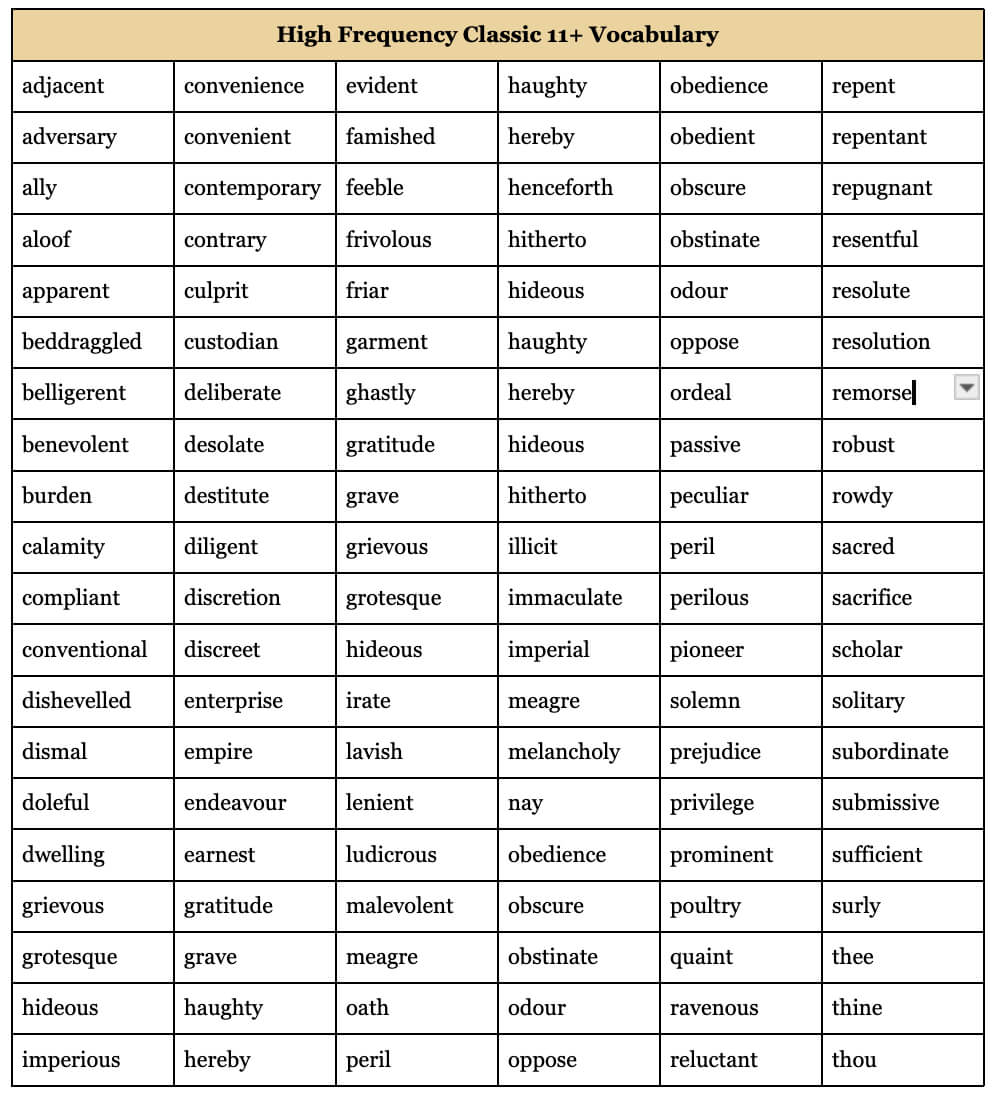
Classic 11+ texts often include older forms of English and words borrowed from French that do not split into neat, familiar morphemes. Words such as hitherto, melancholy, custodian or endeavour may need more direct teaching.
I have compiled a list of those words below, but I would caution against simply rote learning. Instead, encourage your child to interact with the word, write sentences, synonyms and antonyms with them, play games such as Taboo, word association or an oral storytelling game and try to include as many new words as possible.
Classic 11+ Vocabulary List
These are the kinds of "old-fashioned" words that often appear in 11+ comprehension passages and classic texts:
You do not need to "drill" these. Instead, choose one per day. Write it on the fridge. Explore the etymology. Talk about it, act it out or use it in silly sentences and games so they move from passive recognition to active use.
The Passive vs Active Vocabulary Gap
One pattern I see in my 11+ lessons is that children often recognise a word when they see it (passive vocabulary) but cannot use it accurately in a sentence or spot a precise synonym or antonym (active vocabulary).
For 11+ success, we want to:
- Grow your child's passive vocabulary through wide, challenging reading.
- Turn a carefully chosen subset into active vocabulary through writing, speaking and games.
Every time your child writes a sentence with a new word, uses it in a story or spots it again in a new book, you are moving it from the passive side into the active side, which is exactly where it needs to be for creative writing and tricky multiple-choice questions.
11+ Exam Considerations: How Vocabulary Questions Really Work
One of the most common hurdles I see when students face vocabulary questions is not simply comprehension of the word, but also of the question and the multiple-choice options.
Distractors in 11+ Vocabulary Questions
Often, 11+ questions are phrased in such a way that there are several plausible distractors. These are carefully designed to test focus and precision. Here is an example:
Q. Choose the word that is the best synonym for the word in bold.
"Despite the team's best efforts to find a solution, the manager's expression remained inscrutable throughout the lengthy meeting."
- A. hostile
- B. perplexed
- C. unreadable
- D. unavoidable
- E. transparent
There are several plausible distractors in the multiple-choice options above, and students may be tempted to choose the first one that fits into the sentence. They must therefore be trained to read every option carefully and choose the most plausible answer, not just the first one that "sort of works".
Another common occurrence is choosing a synonym when asked for an antonym. I teach my students to circle the keyword "synonym" or "antonym" in the question and keep it in mind throughout the question.
Multiple Meanings and Word Classes
Finally, when students are asked to deduce the meaning of vocabulary in the context of an 11+ comprehension, they are often given just the word and the line numbers, as follows:
- Tom examined the jigsaw that lay scattered across the surface.
- While the challenge initially appeared insurmountable, within moments
- he successfully began to master the logic of the arrangement.
- With increased speed, he expertly navigated the various components,
- slotting them into their correct positions with a sense of certainty.
- Just as his sister entered, merely a handful of gaps remained.
Question: As seen in line 3, the term "master" most nearly means:
- A. owner
- B. possess
- C. understand
- D. disobey
- E. conceal
It is essential to go back to the text and read the word in the full context. First of all, the context can help us to deduce the meaning, as discussed at the beginning of this article. Furthermore, we must consider the word's function within a sentence, as terms like conduct, charge and master frequently shift between nouns and verbs. In this case, "master" most nearly means "understand", rather than "owner". These kinds of questions frequently catch students out.
This is why I place so much emphasis on context clues, word parts and word-class awareness in my teaching.
A Simple Weekly 11+ Vocabulary Routine
To help you put all of this into practice, here is a realistic routine you can adapt at home. You do not need to follow it rigidly, but it can give structure to your week and only takes 5 minutes per day.
Day 1–3: Read and notice. Read with your child and collect 3–5 new or interesting words from their book or from a short 11+ style passage. Jot them down in the vocabulary tracker.
Day 4: Break words into parts. Break them into prefix, root and suffix where possible. Use the Morpheme Mapper or Online Etymology Dictionary to explore their "word family".
Day 5: Use the words. Ask your child to write short sentences using the new words, or weave them into a mini paragraph.
Day 6: Practise in context. Read your child sentences containing the words and have them name a synonym and an antonym for each target word.
Day 7: Review through a game. Revisit the week's words through Taboo, word association, an oral storytelling game or a quick quiz you invent together.
Done this way, vocabulary won't be a last-minute panic.
Frequently Asked Questions
1. How important is vocabulary in the 11+?
It underpins almost every part of the paper. Synonym, antonym and cloze questions test it directly, while comprehension and creative writing reward it indirectly. A child who understands the passage, the question stem and every answer option starts from a much stronger position.
2. How many words does my child actually need to know?
Fewer than most lists suggest. Aim for a core of 150 to 200 exam-relevant words your child genuinely owns: they can define each one, use it in a sentence and spot its synonyms and antonyms. Depth beats a long list skimmed once.
3. What kinds of vocabulary questions come up in 11+ exams?
Although formats vary between exam boards and schools, you will commonly see:
- Synonyms and antonyms
- "Closest in meaning" questions in a short sentence
- Odd-one-out or grouping questions
- Cloze exercises where a word is missing from a sentence or passage
- Vocabulary questions embedded in reading comprehension
Sometimes children are also expected to cope with homophones, multiple meanings and words that change class (for example, master, charge, conduct functioning as nouns or verbs). This is why I place so much emphasis on context clues and word-class awareness in my teaching.
4. What exactly are "context clues", and how do they help?
Context clues are the little hints in the surrounding sentence, paragraph or wider text that help your child work out an unfamiliar word. Instead of panicking and thinking "I don't know this word", they learn to ask: "What else here is helping me?"
These clues might be examples, a brief definition, a similar word or a clear contrast. In the Animal Farm example where Major is "ensconced" on his bed of straw, the later reference to the animals "making themselves comfortable" nudges us towards "settled" or "comfortably arranged". That habit of looking around the word is a powerful exam skill.
5. How can my child practise using context clues for the 11+?
The best practice is built into everyday reading. When you read with your child, pause at the occasional tricky word and model your thinking aloud:
"Let's not grab the dictionary yet. What's happening in this sentence? Is there an example, a definition, a similar word or a contrast?"
On top of that, short, focused exercises (for example, mini passages where they have to choose the best meaning from multiple options or explain which clue helped them) can sharpen the skill. The aim is not to memorise labels like "antonym clue", but to build quiet confidence that they can usually work out unfamiliar vocabulary under timed conditions.
6. What is "morphological awareness", and why does it matter for 11+ vocabulary?
Morphological awareness is your child's ability to spot meaningful parts inside words: prefixes, suffixes and roots. Once they can see these building blocks, long words stop being frightening strings of letters and start to look logical.
For example, in incomprehensible we can see in- (not), comprehend and -ible (able to be). Suddenly, the word simply means "not able to be understood". This way of looking at words is especially useful in 11+ verbal reasoning and comprehension, where children will meet complex vocabulary they may not have memorised beforehand.
7. How can we use prefixes, suffixes and roots at home?
Pick a handful of common prefixes, suffixes and roots and return to them often. When a new word appears in reading, ask what parts your child recognises and what the whole word might mean. Building word families from a single root turns this into a game rather than a drill.
8. What about archaic or "classic" vocabulary that doesn't break down neatly?
Treat these as words to be met and used rather than decoded. Put them in short sentences, hunt for synonyms and antonyms and play games such as Taboo or word association with them. Wide reading of classic children's fiction does most of the work over time.
9. Why does my child still struggle with vocabulary questions even when they know the word?
Very often, the issue is not the word itself but the way the question is written. 11+ papers are full of plausible distractors: answer choices that almost fit, but not quite. Children who rush will often pick the first option that "sort of works", rather than the best option.
Another common trap is mixing up synonyms and antonyms because they skimmed the question stem. I train my students to slow down, circle the key instruction (for example, "synonym" or "antonym") and then compare all the answer choices carefully against the sentence in the text.
10. Where should we begin if we are at the start of the 11+ journey?
If you are just starting, build vocabulary from day one, but do it deliberately:
- Continue to read with your child, read widely and read at a higher level than they might choose alone.
- Aim to tackle at least two classic texts together, as these are rich in the kinds of words that appear in 11+ papers.
- Keep a shared record of new vocabulary, but don't just leave them there. Interact with the words, explore their morphology and etymology and play word games.
Conclusion
Strong 11+ vocabulary is not built by cramming word lists the week before the exam. It grows steadily through wide, challenging reading, curiosity about where words come from and plenty of chances to use new words in speaking, writing and games. Start early, keep it playful and let the vocabulary tracker and classic word list do some of the heavy lifting.
If you would like tailored support with your child's 11+ vocabulary and wider English preparation, please get in touch. I offer personalised one-to-one and small-group lessons in a nurturing learning environment.